
Invisalign retainer: pros and cons of the different options
Invisalign retainer
Invisalign can correct everything from mild to severe misalignments. During treatment, the teeth are gently loosened in a controlled way and moved into the right position. How long the treatment takes depends on the severity of the case. To keep the teeth in their new position afterward, retention is essential. The word "retention" comes from the English verb "to retain" — to hold or stabilize. That is exactly what retention does: it locks in your treatment result.
There are two types of retention: a fixed retainer or a removable retainer. Both have their pros and cons.
Fixed retainers
A fixed retainer is a thin wire that is bonded to the inside of the teeth and stabilizes them 24 hours a day. The wire only covers the front teeth and can be placed on the upper or lower arch. As a rule the retainer stays in the mouth for several years and prevents the teeth from drifting back to their original position. There are different versions: a 3-3 retainer covers from canine to canine, while a 4-4 retainer also includes the first premolars. A wire retainer is the easy option for retention — it does the work in the background without any effort on your part.
The downside of a wire retainer: it makes oral hygiene harder. You can no longer floss the usual way. With a fixed retainer it is especially important to keep up with regular professional cleanings. If the spaces between the teeth are neglected, plaque, tartar, inflammation and even cavities can develop. Heads up: if the bonding ever partially comes loose, there is a risk of swallowing the wire or injuring the mouth — see your dentist as soon as possible.
Why fixed wires can be problematic
- Plaque and tartar build-up: the wire creates hard-to-reach areas that cannot be cleaned thoroughly. That sets the stage for tartar and gum inflammation.
- Damage that goes unnoticed: if the wire partially comes loose, a tooth can rotate out of place without the patient noticing right away.
- Permanent dependency: the patient has no active control — the wire works passively and only stabilizes for as long as it stays perfectly in place.
→ Nighttime retainers sidestep exactly these risks: they are removable, hygienic, easy to monitor, and they work actively against teeth drifting back.
The Memotain retainer
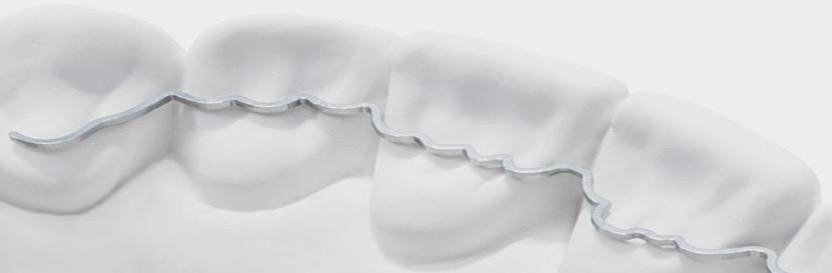
At SmileClubONE we use the fixed Memotain retainer, because it has a lot of advantages over a standard wire retainer. Memotain is a lingual retainer — it is bonded to the inside (tongue side) of the teeth. What sets the Memotain apart is the technology. Just like the aligners, it is made from a 3D scan. Unlike other retainers, the Memotain wire is not bent into shape — it is laser-cut for each patient from a single piece of nitinol. It does not change its shape over time. That matters a lot for stabilizing the teeth, because this method introduces no tension that could cause unwanted shifts. Memotain is also much thinner (0.4 mm) than standard steel retainers, which makes it more comfortable to wear. With a special floss (with a reinforced end), you can even clean the spaces between the teeth by threading the floss underneath the retainer.
The Memotain retainer process works as follows:
- 3D scan: the scan produces a digital, precise impression of your teeth.
- Laser cutting: the individual retainer is computer-cut from nitinol using laser technology. No bending is involved.
- Polishing: the retainer is polished and the outer layer is removed, leaving a smooth, germ-resistant surface.
- Bonding: thanks to the 3D scan the retainer fits perfectly, and our dentists bond it into place.
Nighttime retainers
The nighttime retainer (a removable retainer) is the gold standard for retention today. It works actively: if a tooth starts to drift, the tray applies pressure again and pushes it back into position. A fixed wire retainer is problematic by comparison — if it comes loose unnoticed, teeth can rotate out of place permanently, often before the patient catches it. A nighttime retainer does not carry that risk. Even if you forget it for a few weeks, just wearing it consistently again is enough: the initial tension on insertion shows you that the tray is actively pulling the teeth back into line.
Bottom line: more safety and more control for the patient — which is why the nighttime retainer is considered the most reliable form of retention.
Is a retainer really necessary?
You spent months — maybe years — getting your teeth exactly where you always wanted them. It would be a real shame to see all that work undone. Without a retainer the teeth will very likely drift and turn crooked again. The relapse rate after 10 years sits at around 90%. After a successful treatment, do not skip the retainer — that is what locks the result in for life.
How long do you need to wear the retainer?
The first year after treatment is the most important for a lasting result. Lifelong retention is actually recommended. If that is not an option for you, try to keep the retention phase running at least as long as your active treatment lasted. Most patients do not even notice their retention, and their teeth stabilize fairly quickly.
Retainer cost
At SmileClub One we offer the 7Smile nighttime retainers. The price is 135 € per set. As an alternative, a Memotain wire retainer is available at 200 € per arch (400 € for both arches).
Special deal: when you buy 3 sets of nighttime retainers, you get an additional set free of charge.
For patients over 18, statutory health insurance generally does not cover the cost. Private supplementary or full insurance plans may reimburse part or all of it. For children and adolescents, the cost of the retainer is usually covered by statutory health insurance.
Nighttime retainers for external patients
Due to high demand, we also offer our 7Smile nighttime retainers to patients outside the SmileClubOne network — not just to our own members. Shipping happens only in coordination with the treating dentist, so that medical supervision and safety are guaranteed at every step.