
Invisalign attachments: what you should know about them
Invisalign attachments: everything you should know about the small composite anchors that make clear aligners work. We answer the questions we hear most often.
Invisalign is the market leader for clear aligner therapy. With this treatment, your teeth are corrected orthodontically without any visible metal wires or brackets — the tooth movement happens through the regular swap from one tray to the next.
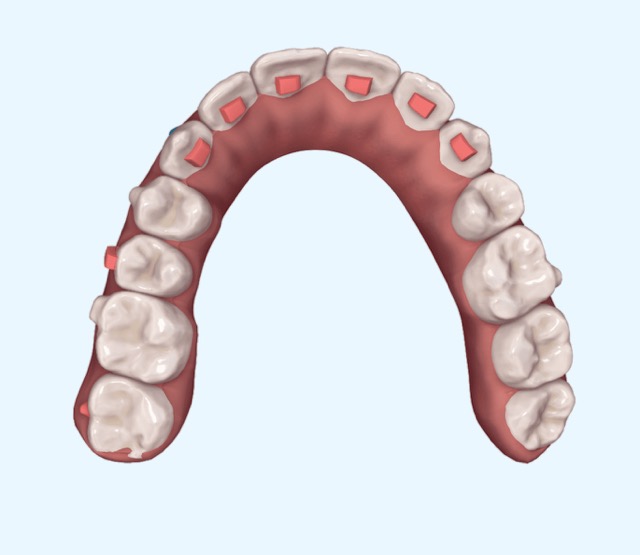
Attachments can play a huge role in the success of the treatment. Invisalign attachments are small fixtures made of composite (a tooth-colored substance) that help the tooth movement happen faster, more easily and more efficiently. More precisely, they act as anchors that the aligner grips to deliver the movement. Attachments let the necessary force be applied to a tooth with real precision. They also enable complex movements such as rotations and help the correction progress without unnecessary "in-between" steps.
How many attachments do you need?
The number of attachments is completely individual and tailored to each case. It is possible that no attachments are needed at all, or that they are placed several months into your treatment because they only become relevant for a later tooth movement.
Invisalign without attachments
As mentioned above, an Invisalign treatment can also be done without attachments. For some misalignments attachments are simply not necessary, are left out by patient request, or are scheduled for a later stage. A treatment without attachments usually means more trays are needed to reach the result you want. During a consultation we can tell you whether attachments are necessary in your case.
Are Invisalign attachments visible?
The attachments come in different shapes and are carefully modeled to match the planned tooth movement. Their color is matched to your own tooth shade, so they are barely visible and only noticeable on close inspection.
Attachments on the inside of the tooth
An alternative is to bond the Invisalign attachments on the lingual (inner) side of the tooth. The small dots stay neatly hidden while still doing their job. Inside-bonding is not suitable for every treatment — some misalignments simply do not offer enough space for it. Please discuss this with your dentist in person. There is also an additional cost for placing attachments on the inside, which you can find listed under Add-Ons.
Invisalign attachment technology
Invisalign attachments are not the same as the attachments from other aligner providers. They are just one of many advantages that other manufacturers cannot replicate, because Invisalign holds the exclusive rights to these small composite dots and to over 660 other proprietary features. Without attachments, many movements cannot be delivered effectively. Years of Invisalign research have shown that complex cases cannot be corrected without these patented attachments. This innovative technology is what sets Invisalign apart from other aligner systems and allows it to correct even severe misalignments as a full orthodontic treatment.
Lost an Invisalign attachment — what now?
An Invisalign attachment can (in rare cases) come off. Usually that happens because a bit of saliva got between the tooth and the adhesive during bonding, so the composite never bonded fully. It is not a big deal — it can simply be re-bonded. Tell your dentist; they will order a new template so the lost attachment can be placed again.
Invisalign attachments — discoloration, what to do?
Some foods like turmeric, curry or blueberries can leave small stains on the attachments. If your normal oral hygiene routine does not remove them, book an appointment at the practice. The team can clean these stains off easily. Learn more about possible Invisalign tray discoloration and how to remove it.
Removing Invisalign attachments — when do the attachments come off?
After your treatment is successfully completed, the attachments are removed from your teeth. You are probably wondering: will this leave marks or damage my teeth? You can relax — attachments leave no residue on your teeth. Your dentist will remove them so that no composite or adhesive stays behind. Neither placing nor removing the attachments harms your teeth.