
Clear aligners vs. Invisalign: which tray is better?
Clear aligners vs. Invisalign: which tray is right for you? Everything you need to know about the differences between the clear orthodontic trays.
Clear aligners vs. Invisalign
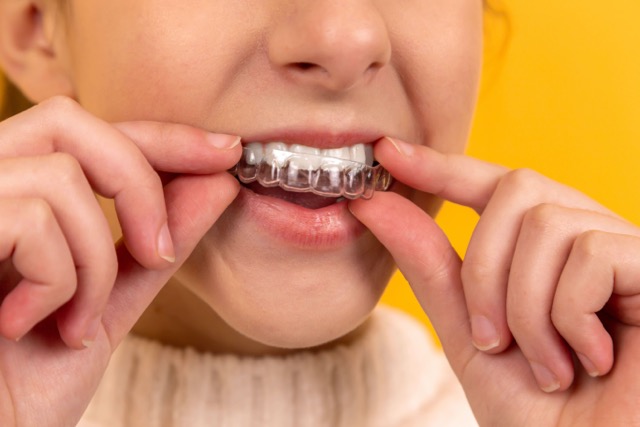
Straightening your teeth with clear trays has become a hugely popular alternative to fixed braces in recent years. The promise is appealing: no brackets, no permanent wires, no food getting stuck. A genuinely great alternative to metal braces — a tray that you can barely spot at first glance, and yet manages to correct a whole range of misalignments.
So the question is: are all clear trays created equal? The answer — no. They look very similar, but there are significant differences in how they actually work. The key distinction is between cosmetic trays and orthodontic trays. That classification defines how much correction the aligners can deliver.
How do you pick the best tray for you, then? What is the actual difference between one provider and another? This article walks you through it all.
The history of clear orthodontic trays
Removable, paper-thin plastic trays have been used in Germany as a way to correct misaligned teeth since 2001. Until 2017 Invisalign held a patent that prevented other companies from producing their own clear trays. When the patent expired, start-ups around the world began making their own versions of the in-demand trays.
While Invisalign spent two decades of research perfecting their aligners, other companies entered the market quickly. There are now many aligner manufacturers, but most of them focus on the cosmetic version of the tray. On the orthodontic side of the market, the options are far more limited.
Cosmetic-tray providers include Dr. Smile, Best Smile, Smile Direct Club and Plus Dental. On the orthodontic side, the main names are Invisalign and ClearCorrect.
How do clear aligners differ from Invisalign?
The single biggest difference between cosmetic clear aligners and Invisalign is that Invisalign delivers a full orthodontic correction. Invisalign invented the clear tray and still holds 660 patents worldwide that protect the system from copycats. It is not only the trays that are unique — the iTero scanner also brings cutting-edge technology. The scan helps trained providers capture an aligner fit that is seven times more accurate. The results: more precise treatment outcomes than ever.
The developers of purely cosmetic trays usually lack the resources and the means to deliver orthodontic treatment. A cosmetic correction means that only the position of the front 6 to 8 teeth can be changed. For patients with very mild misalignment that may be enough. For everything else, this kind of straightening is not the right choice.
A specialist dentist or orthodontist is the right person to assess which type of misalignment is present and which treatment is best suited to the patient. On top of that, both the treatment timeline and the cost change with every provider.
What are the advantages of Invisalign?
A major advantage of the Invisalign system is the patented attachments. Attachments are small composite anchors bonded to the tooth. The color of the attachments is matched to your natural shade — some patients need none at all, others need several. They help move the teeth precisely in the desired direction. Canines, for example, are hard to rotate, and attachments are essential for that kind of movement. Cases Invisalign can treat include crowding, gaps, overbite, underbite, edge-to-edge bite, crossbite and open bite.
The trays themselves and the material they are made from also differ from other manufacturers. Invisalign trays are tougher because they are made from SmartTrack material. This special plastic enables more controlled treatment and moves teeth up to 50% faster compared to other aligners. Learn more about what makes Invisalign different.
Medical standards and provider supervision
Another major difference between aligner providers is the diagnostics. The treatment offered by many manufacturers has come under sharp criticism for proceeding without medical supervision. In many cases, the teeth are only scanned once at the start of treatment in the office, and the trays are then shipped to the patient's home address. The patient runs the therapy themselves, with no interim exams, no halfway check-ups and no follow-up appointments.
The BDK (the German Federal Association of Orthodontists) is sharply critical of this approach, because only regular exams and check-ups can catch complications early.